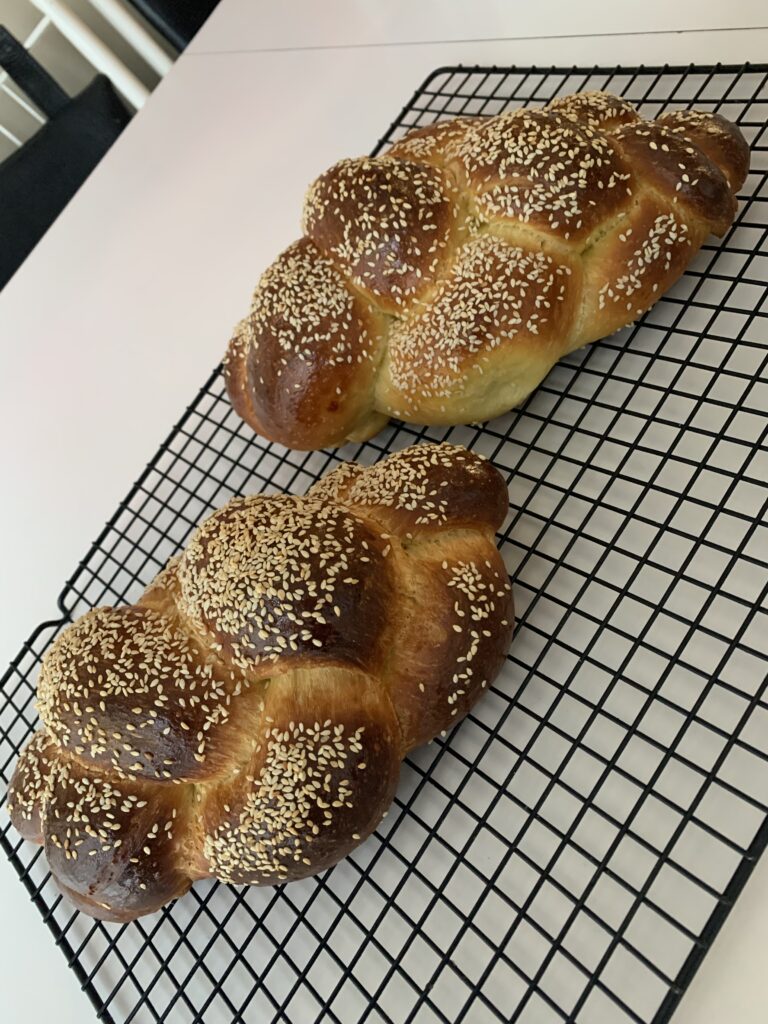
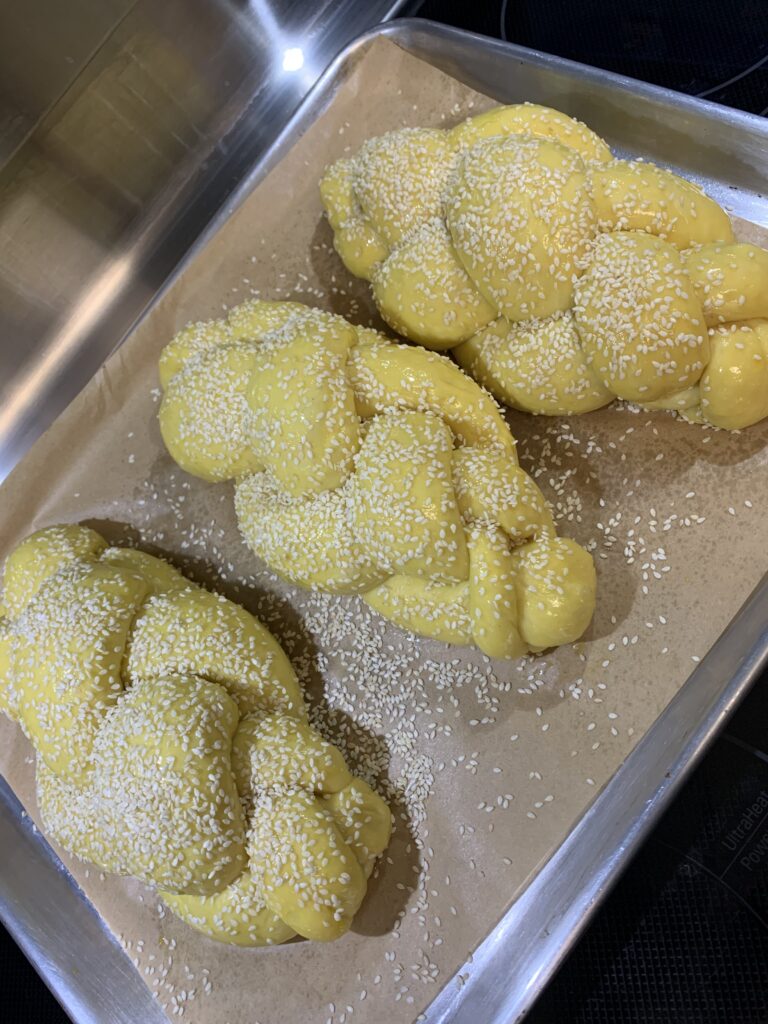
This was one of the first breads I made on my journey to recreate my late bubbe Stella’s z”l challah, and while it didn’t exactly meet the mark, it turned out to be a fantastic bread, and the perfect receptacle for a late night grilled cheese or Sunday morning French toast casserole.
Pros: The director of the King Arthur Flour Bakery, Jeffrey Hamelman has developed a fantastic dough for the first-time bread baker. Whether you choose to knead it by hand or with a stand mixer, it’s a super firm, elastic dough that will allow you to practice making the most beautiful strands and braids with ease. My one word of caution is if you’re using a mixer, use the dough hook on a slow speed, and give your motor several breaks to cool down. And no matter which braid style you choose, you’ll be amazed at how gorgeous it comes out, with zero pulling or splitting.
Cons: I proofed this bread in the fridge overnight and after an hour I noticed the surface was dry. That dryness is a no-no for challah. It can inhibit proper rising and result in a tough, leathery crust. So, while the recipe does not call for it, I sprayed oil on top of the dough for the remainder of the time it was in the fridge, and that helped a lot.
Some people love their challahs to have a dense crumb and dark crust. If that’s you, follow the recipe to a tee. If you’re more like me and prefer a golden crust, cover it loosely with foil after the first few minutes in the oven, or place a sheet tray on the oven rack above. You can also lower the oven temp by 25 degrees as soon as you place the challah in the oven, but keep an eye on it. Every oven is different, and most will have large temperature fluctuations so it could go down too much, causing it to dry out even more.
Adapted Recipe
| Weight | Ingredient | Baker’s % |
| 930 g (1/3 c) | All purpose flour | 100% |
| 302 g (1 1/3 c) | Water | 32.5% |
| 17 g (1 tbsp + 2.1/2 tsp) | Instant yeast | 1.8% |
| 150 g (3 large) | Eggs, large | 16.1% |
| 54 g (3 large) | Egg yolks, large | 5.8% |
| 99 g (1/2 c) | Sugar, granulated | 10.6% |
| 18 g (1 tbsp) | Salt, fine table | 1.9% |
| 66 g (1/3 c) | Oil, vegetable | 7.1% |
Directions
- Place all of the ingredients in the mixing bowl of a stand mixer, starting with the liquids and ending with the dry. Make sure not to put the salt and yeast too close to each other.
- Knead the dough on speed 1 (KA 1) for 5 minutes, stop the machine and let the dough rest for 5 minutes to allow your mixer to cool down, then continue on KA 2 for 3-5 minutes or until the dough is smooth, well-developed and passes the windowpane test.
- Cover the bowl with plastic wrap and allow to rise at room temperature for one hour, then place in the fridge for another hour or until it is thoroughly chilled.
- Remove from the fridge and transfer to a lightly greased work surface. To make two 4-strand braided challahs, separate the dough into eight pieces of equally weighted dough. Pre-shape each piece into a log, careful to keep the smooth side of the dough on the outside.
- Cover the logs and allow them to rest for 15-20 minutes.
- Uncover the logs and roll each strand to approximately 20″ each, making sure to taper the ends. To make a 4-strand braid, join the strands together at the top by pressing the ends together. Now, assign all four braids a number and move #4 over #2, then #1 over #3, then #2 over #3 and repeat. Once you’ve finished braiding, press down the ends together, flip to the bottom, and give the whole loaf a couple of rolls.
- Place both challahs on a parchment-lined baking sheet and cover with plastic (I use fragrance-free recycling bin bags) and allow to proof until they’re doubled in size, about 1.1/2 to 2 hours, but your kitchen climate may be different than mine so remember to do the poke test to double check. Towards the end of the proofing time, preheat your oven to 375*F.
- Bake the loaves for 25-30 minutes or until they reach an internal temperature of 190*F using a digital thermometer. Remove from oven and place on a wire rack to cool.
If you’re interested in learning more from the master himself, get the full recipe and watch him make the challah in real time here.
Leave a Reply